
A few months ago, I attended a webinar with Dr. David Nowell, a renowned clinical psychologist and expert in ADHD and neurodiversity. I walked away with a lot of great information, but one concept has stuck with me—and it has become one of the most useful tools I use with my clients. It’s called the 4-Quadrant Framework, and if you have ADHD or executive-functioning challenges, I think it might be useful for you, too.
What Is the 4-Quadrant Framework?
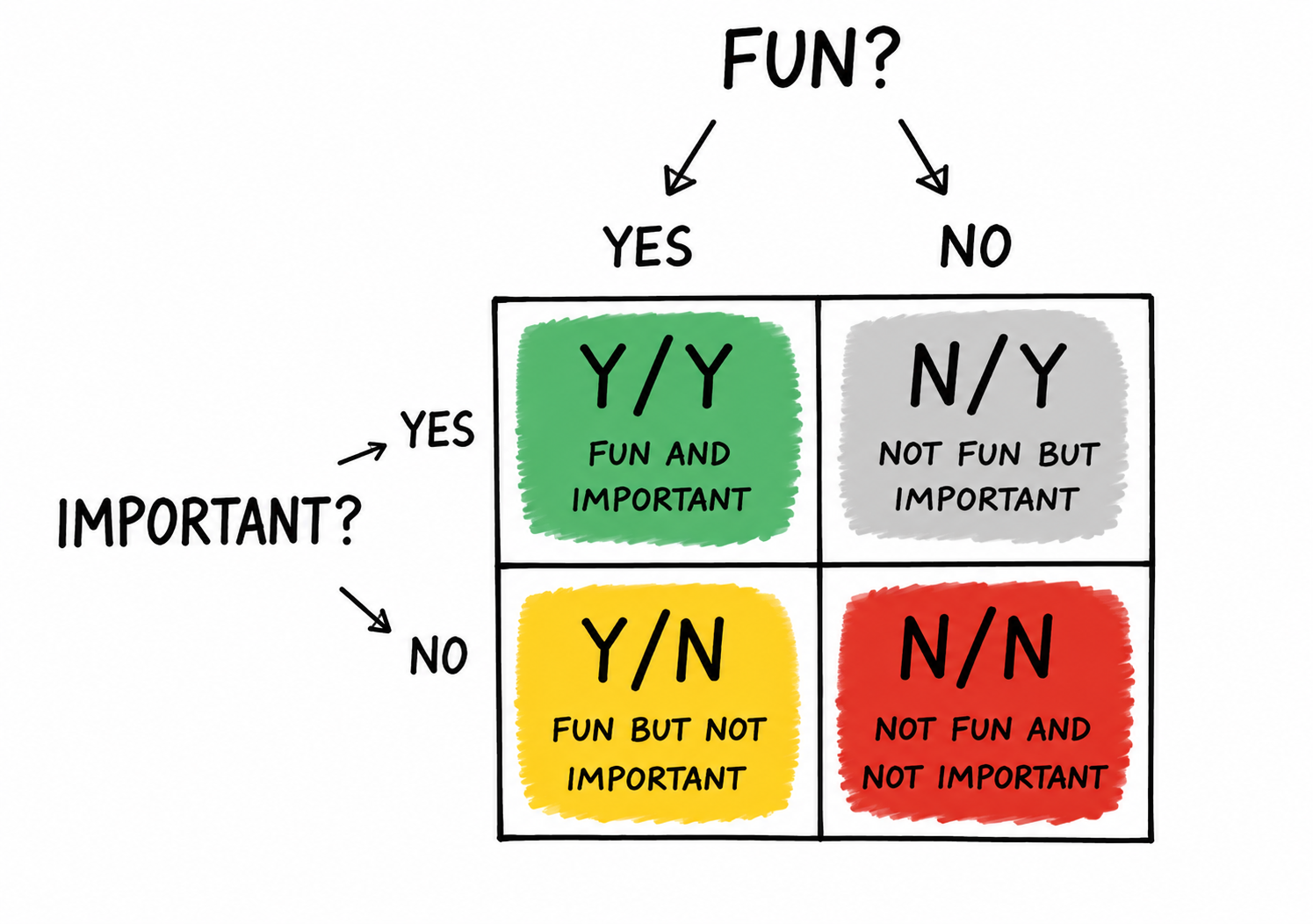
The framework is simple, but incredibly powerful. Every task or activity in your life can be sorted into one of four quadrants based on two questions: Is it important? And is it fun?
The green quadrant (Fun and Important) is your sweet spot—these are the enjoyable activities that align with your values and the life you want to build. Think about spending quality time with family and friends, or diving into a hobby that lights you up. Ideally, this is where you want to spend as much of your time as possible.
The gray quadrant (Not Fun but Important) is where things get hard, especially for the ADHD brain. These tasks matter — a lot — but they’re not enjoyable, and sometimes they can feel downright painful to tackle. Paying bills, responding to emails, cleaning up the kitchen after cooking — we all have our versions of these.
The yellow quadrant (Fun but Not Important) is one to watch. These activities feel good in the moment, but they can quietly pull you away from what you actually need to be doing. Social media is a classic example — or falling down an internet rabbit hole when you sat down to do something completely different. Sound familiar?
The red quadrant (Not Fun and Not Important)—The goal is to stop spending time here. These tasks drain your energy without giving anything meaningful back. An afternoon spent reorganizing a junk drawer instead of finishing a work project, making an important call, or spending time with family — the drawer’s neater, but nothing that truly matters has moved forward.
Why This Matters So Much for ADHD
If you have ADHD, you already know that your brain doesn’t always cooperate with the tasks on your to-do list. You might find yourself hyperfocusing on something that feels urgent but doesn’t get you any closer to your goals. Or you might be avoiding something important because it feels overwhelming, tedious, or difficult to start.
The 4-Quadrant Framework gives you a way to step back and ask yourself, “Where am I actually spending my time and energy? And most importantly, is it working for me?
How I Use This with My Clients
One of the first things I do with a new client is help them map out their tasks using this framework. It’s a real eye-opener. People are often surprised to discover how much time they’re spending in the yellow and red quadrants — and how little time they’re spending on what truly matters.
I worked with a therapist in private practice who was feeling burned out and overwhelmed. When we mapped out her tasks, the picture became very clear.
Her green quadrant (Fun and Important) included writing, journaling, reading therapy books, and providing therapy sessions — where she thrives and makes her greatest impact. We made sure she built this into her routine.
Her gray quadrant (Not Fun but Important) included daily notes, returning client calls and emails, and billing. These tasks were essential to her practice but a real struggle for her. We focused on building ADHD-friendly strategies to make these tasks feel more manageable.
Her yellow quadrant (Fun but Not Important) included listening to podcasts and taking personal phone calls during work hours. Fun, but not important to her practice. We worked together to minimize these derailments as much as possible.
Her red quadrant (Not Fun and Not Important) included updating her website when she already had a full caseload, scrolling Psychology Today to compare her profile to other therapists, and reorganizing her office closet. We took those things off her plate—or at the very least, off her calendar.
Once she could see it all laid out, the path forward became so much clearer—and that’s when the real work began.
What About You?
If any of this resonates with you, I invite you to try using this framework to map out your own tasks. Ask yourself:
- Where am I spending most of my time?
- Where do I want to be spending it?
- What’s one thing I can take off my plate that’s draining my energy?
This is exactly the kind of work we do together in coaching — helping you get unstuck, finding clarity, and focusing on what actually matters. If you’re ready to explore what that could look like for you, I would love to connect. Schedule a complimentary get-acquainted session here and let’s talk!

Andrea Yellinek, MS, OTR/L, CACP
ADHD Coach and Life Coach, Executive Skills Coach